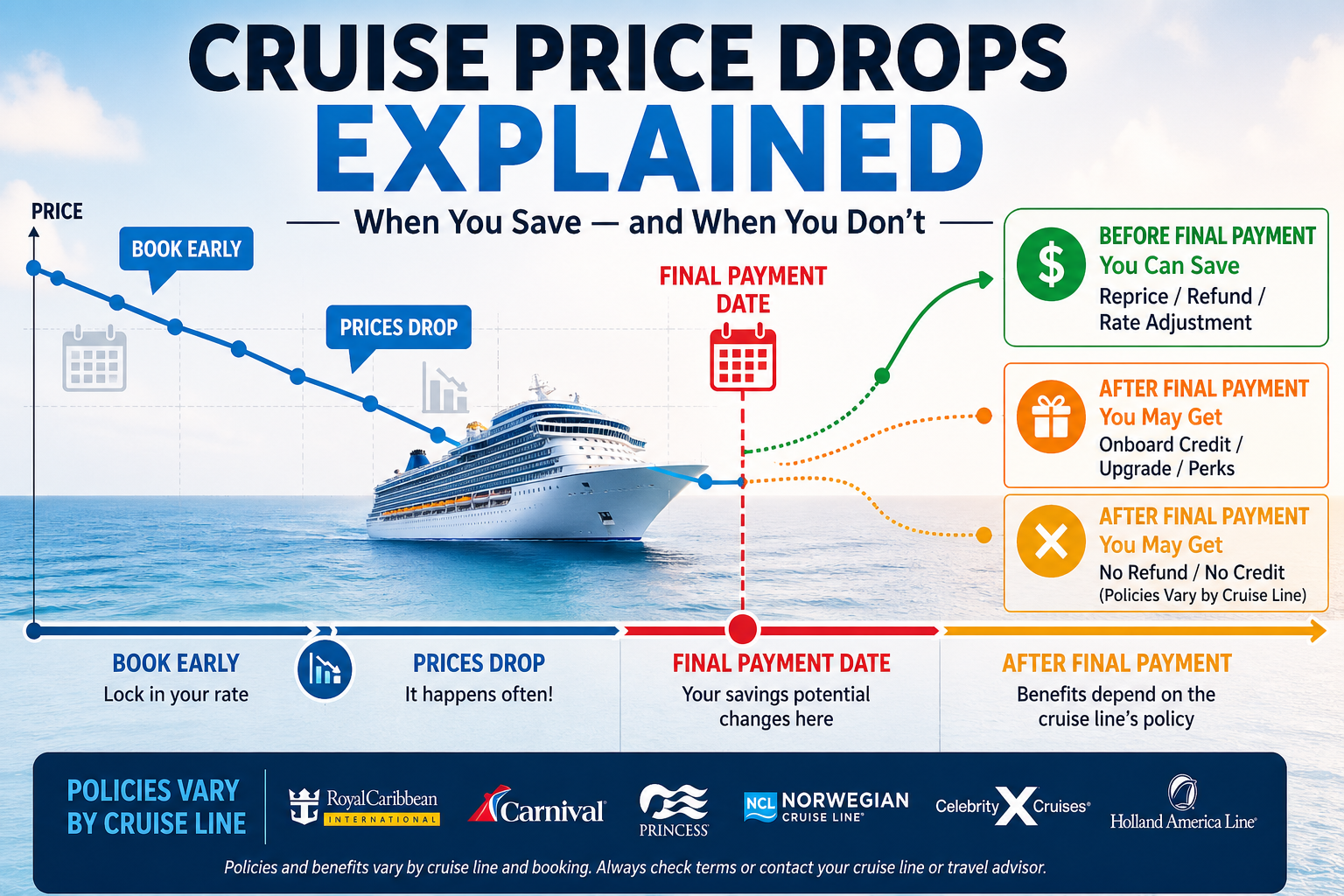
Cruise Price Drops: What the Lines Won't Tell You — and What to Do When It Happens
Cruise lines adjust fares constantly. Multiple times a day, in some cases. And when the price on your sailing drops below what you paid, not one of them will send you an email. Not a notification. Not a flag in your account. Nothing.
That's not really a gap in the system — it's more or less how the system is supposed to work. The pricing algorithm runs on the assumption that most passengers aren't watching, and most aren't. The ones who end up getting money back are generally the ones who know what the policy actually says, check at the right time, and call before the window closes.
We monitor fare data across 32 cruise lines at Cruise Alert. The pattern is consistent: qualifying drops appear across all of them, briefly, and most go unclaimed. Not because the policy doesn't apply — because nobody was watching at the right moment.
Here's how it works across the major lines, what you'll actually receive when a drop qualifies (it's not the same everywhere), and where the window closes for good.
The short version
Fare adjustments are available at virtually every major cruise line — but only before your final payment date. After it, most options close or disappear entirely.
The lower fare must match your exact cabin category code — not the room type, the specific alphanumeric code in your confirmation. This single detail determines whether your claim qualifies.
No line will notify you. Our data across 2.6 million Royal Caribbean price snapshots shows Saturdays produce roughly 10x more significant fare drops than Mondays. If you're checking manually, that's your day.
When you reprice, your original promotions are replaced. A lower fare can be a worse total deal. Always run the full math before accepting.
Cruise Alert monitors your sailing and alerts you the moment a qualifying drop occurs — before the price bounces back.
The Mechanic Nobody Explains at Booking
Every major cruise line runs a dynamic pricing engine — the same model airlines and hotels use, but with one meaningful difference. A cruise booking can be repriced after the fact, down to a lower fare, if a specific set of conditions is met. That doesn't happen automatically. It happens when you ask.
The engine watches cabin fill rates against the line's internal booking targets. When a sailing outpaces expectations, prices rise. When it lags, they fall. Neither direction gets communicated to passengers already holding reservations.
The fare you paid when you booked is not the floor. It's not the ceiling either, for that matter. It's just a snapshot of one moment in a system that keeps moving after you've left the booking page — and whether you ever benefit from that movement is mostly a question of whether you're paying attention.
The Rule That Holds Across Every Line
Thirty-two lines. Different companies, different programs, different names for the same protection. Underneath all of it:
Before your final payment date, fare adjustments are available at virtually every major cruise line. After it, most options close — and some close entirely.
The final payment date is the operating boundary. Before it, the line has every reason to keep your booking intact at a lower fare. After it, that incentive disappears. What changes between lines is everything around that boundary — what you receive, whether your promotions survive, what post-payment paths exist. Those differences are significant. But the boundary itself is universal.
Know your final payment date. Put it somewhere visible. Honestly, everything in this guide — and the line-specific guides — is operating inside that window. Once it passes, your options change considerably.
The Requirement That Kills Most Claims
The lower fare has to match your exact cabin category code. Not your room type. The code.
Cruise lines price cabins at the subcategory level. On Royal Caribbean, a 4D balcony and a 2D balcony are different categories even when the cabins are physically identical. Most passengers checking for a price drop look at the general balcony page and miss that the drop they found is in a different subcategory. The claim gets denied. The passenger thinks the policy doesn't work.
It does work. The code has to match. Find your exact alphanumeric category code in your booking confirmation — not the room type label, the actual code — and use it for every price check you run. (We hear from users fairly regularly who were told their claim was denied and are convinced the policy doesn't apply to them. Almost every time, when we walk back through it, the issue isn't that the policy failed — it's that the fare they were comparing wasn't actually in their cabin category. Different subcategory code, same-looking cabin, invalid comparison.)
Three more exclusions that apply everywhere: third-party OTA prices never qualify on any line under any program. Restricted rates — casino fares, net rates, travel agent rates — are carved out across the board. And the lower fare must still be available when your claim is reviewed. If the price bounced back before an agent processes the request, the claim is denied.
You Won't Always Get Money Back. Know the Difference Before You Try.
Most passengers assume a price drop means cash back. On some lines it does. On others, it doesn't — and knowing which you're dealing with changes the math.
Fare reduction means the line lowers your booking to the new price. If you've already paid more, the difference goes back to your payment method. Real money, returned.
Onboard credit means the savings live on the ship. You spend it on drinks, dining, excursions, spa. Whatever's unused at voyage end may or may not be refunded depending on the line. For a passenger who spends freely onboard, OBC at full face value is roughly equivalent to cash. For someone running a lean onboard budget, it's worth meaningfully less.
Carnival's Early Saver fare gives you OBC after final payment, not a refund. Princess issues 120% OBC — slightly more than the price difference, but only if you spend it. Holland America's formal protection is OBC only, and only within 72 hours of booking. Norwegian offers a Future Cruise Credit after final payment, which requires planning another sailing to redeem. None of this is disclosed prominently at booking.
The Promotion Problem — Why a Lower Fare Sometimes Isn't
This is the part most guides skip. Partly because it complicates the story, and partly because it requires passengers to do actual math rather than just celebrate a lower number.
Across every line that allows repricing, the same caveat applies: when you accept a new lower fare, you accept the current promotions attached to it. Your original promotions are replaced.
This is the most common reason a lower fare ends up not being the better deal.
Before requesting any reprice, check what your current booking carries — onboard credit, drink packages, free gratuities, reduced deposits, dining credits — and compare it to what the new fare offers. A $100 fare drop that comes with $150 less in onboard credit costs you $50. A $200 fare drop with no promotions versus your original booking with $300 in OBC is a loss. (This catches more people than you'd expect. The fare number is visible and memorable; the promotion value is buried in confirmation emails most passengers haven't reread since booking.)
Take the time to add up what your current booking is actually worth — the fare plus every perk attached to it — and compare that total to what the repriced booking would look like. Sometimes the new fare wins clearly. Sometimes it doesn't. You're never required to accept a reprice, so if the numbers aren't in your favor, just say so and end the call.
How Each Major Line Handles It
Royal Caribbean
The most volatile pricing of any mainstream line and the most detailed repricing policy. Before your final payment date, Royal Caribbean will adjust your fare to match a lower price on the same sailing, ship, and cabin category — for US, Canadian, and most international guests. UK residents are not eligible.
If you've already paid in full, the difference is refunded to your original payment method. Within 48 hours of your original booking, the Best Price Guarantee applies regardless of payment status — useful if you book and the price drops that same weekend.
After final payment, a complimentary upgrade is possible if a higher cabin category drops to or below what you paid — but it's availability-dependent, not guaranteed. The previous option to take the price difference as 110% onboard credit after final payment has been removed from the current policy.
Excluded rate types: net rates, casino rates, travel agent Friends & Family and Reduced rates, complimentary staterooms, and group bookings.
→ Royal Caribbean price drops: the complete guide
How to claim: call 866-562-7625 or contact your travel agent. No online form exists for standard repricing. If the first representative denies a valid claim, call back — incorrectly denied BPG claims are a documented, recurring pattern. Ask specifically for someone who handles fare adjustments and reference the Best Price Guarantee by name.
Carnival Cruise Line
Carnival operates two distinct protection tracks, and the difference between them is significant.
The Lowest Price Guarantee is a 48-hour post-booking window: find a lower publicly advertised Carnival fare within 48 hours of booking and the difference is issued as 110% onboard credit. Useful if you're quick.
The Early Saver fare is the more powerful option — ongoing price protection from booking through two days before sailing. Before final payment: the fare is repriced down to match the lower price. After final payment: the difference is issued as non-refundable OBC. No other mainstream line offers a protection window this long.
The catch: Early Saver deposits are non-refundable, and a $50 per-person change fee applies to ship or sail date changes before final payment. The fare must be publicly available on Carnival's website at the time the claim is reviewed. Group rates and travel agent-only promotions don't qualify.
How to claim: submit the price protection form at carnival.com/request-forms/price-protection. The most frictionless reprice process of any major line.
Norwegian Cruise Line
Norwegian's Best Price Guarantee runs from booking through the final payment date — standard framework. Where NCL gets complicated is the promotion problem, and it's worth slowing down here because Norwegian is the line where passengers are most likely to walk away from a "savings" call feeling like they actually lost something. NCL bundles are often generous at booking: Free at Sea perks like drink packages, specialty dining, Wi-Fi, and shore excursion credits are common inclusions. When you reprice, those get replaced by whatever's currently running. If the current promotion is weaker — which it often is mid-cycle — a $60 fare drop can come with $150 less in perks. Take ten minutes before calling to write out the full value of what your booking currently includes. The comparison needs to be total value, not headline fare.
After final payment, Norwegian offers two paths, provided the sailing is fully paid and at least 14 days out: a complimentary upgrade equivalent in value to the price difference (subject to availability), or a Future Cruise Credit at 100% of the difference, valid for sailings of six nights or longer within two years. The FCC is the more reliably useful of the two — but only if you're planning to cruise with Norwegian again. For a first-timer, it requires committing to another booking to extract any value, which may or may not fit your situation.
How to claim: contact Norwegian directly or through your travel agent. Post-final-payment claims require a price drop coupon request, with eligibility confirmed within seven business days.
Celebrity Cruises
Celebrity's Best Price Guarantee mirrors Royal Caribbean's structure — repricing from booking to final payment, plus a 48-hour window after booking regardless of payment status. If you've paid in full, the difference is refunded.
The standout feature: if Celebrity adds promotions — onboard credit, dining credits, other perks — after you've booked, you can request those perks be added to your booking even if the fare hasn't dropped. No other major line offers this added-value protection alongside standard fare repricing.
After final payment, upgrades are handled case by case with no formal refund mechanism.
How to claim: call 1-888-751-7804 or contact your travel agent.
Princess Cruises
Princess's Better Than Best Price Guarantee applies to eligible bookings on select sailing windows. When a lower publicly available fare appears before the final payment date, Princess issues onboard credit at 120% of the price difference — slightly more than the drop itself, but only if you spend it. The same bundle (Princess Plus or Princess Premier, if applicable) must be included in both the original booking and the lower fare for the claim to qualify.
Outside the Better Than Best program, Princess has a standard 72-hour window post-booking during which a price match can be requested. After final payment, there is no formal protection.
Princess policies on this have evolved and continue to change. Verify current terms at princess.com before assuming coverage.
How to claim: submit the Guarantee Claim Form at princess.com/plan/best-price-guarantee.
Holland America Line
Holland America's formal price protection is the most limited of any mainstream line: a 72-hour post-booking window giving 120% OBC for the price difference. Outside that window, there is no published standard repricing policy.
Some agents succeed in requesting a courtesy reprice before final payment when the same category is available at a lower fare, but this is at Holland America's discretion — not a stated right. The Have It All bundle must match between the original and lower fare for any claim to qualify. Formal protection is available to US and Canadian residents only. (If you're a HAL regular, you probably already know this, and you probably already have an agent who handles it for you. If you're new to the line, it's worth knowing before you book that the safety net here is thinner than what Royal Caribbean or Carnival offer.)
How to claim: submit the Best Price Guarantee form at hollandamerica.com/en/us/cruise-deals/best-price-guarantee.
MSC Cruises
MSC does not publish a formal price-drop or fare repricing policy. Once booked, the fare is generally locked in — even if the same sailing appears at a lower price on MSC's website the next day. Before final payment, some guests and travel agents have succeeded in requesting a discretionary reprice, but success depends on the representative, not a stated policy.
The practical approach: book during a sale period, monitor before final payment, and ask. An experienced travel agent with an MSC relationship improves your odds more than on any other line. There is no guarantee.
Virgin Voyages
Virgin Voyages operates one of the narrowest price protection windows in the industry — 48 hours from the moment your booking confirmation is generated. Within that window, the Best Price Guarantee is legitimately useful: if you find a lower fare for the same voyage, sail date, and cabin type anywhere — including on third-party sites, which most lines explicitly exclude — Virgin will match it. That's a meaningful differentiator. Most lines only honor their own published fares.
What you receive depends on where you are in the payment process. If you're partially paid, the fare is discounted to reflect the difference. If you're fully paid, the difference comes back as Future Voyage Credit — not a refund to your card. FVC can be applied to add-ons and Bar Tab purchases, which is useful if you were planning to spend onboard anyway. Less useful if you were hoping to get cash back.
The trip-up on Virgin claims is promotion combinability. If your original booking included a promotional offer — bonus Sailor Loot, an included Bar Tab credit, a bundled package — and the lower fare is running under a different promotion that isn't combinable, the claim gets denied. Screenshot the current promotion on Virgin's website before submitting anything, and compare it directly to what your booking carries. The fare is only half the equation.
Outside the 48-hour window, there is no formal ongoing price protection. Virgin's pricing does move — promotional sailings, flash sales, and Red Hot events can produce meaningful fare shifts — but after that initial 48-hour window closes, you have no documented repricing right. The practical approach if a fare drops later: contact Virgin or a travel agent and ask for a courtesy adjustment. Outcomes are inconsistent.
One structural note: Virgin launched VoyageFair Choices in October 2025 — three distinct fare tiers with different flexibility, cancellation terms, and amenity inclusions. The tier your booking sits in affects what the "same fare type" means for a BPG claim. If you're comparing your booking to a lower fare in a different tier, it likely won't qualify.
How to claim: submit the Best Price Guarantee form on virginvoyages.com within 48 hours of booking. Virgin reviews submissions within 72 hours.
→ Virgin Voyages price drops: full guide — /blog/virgin-voyages-price-drop-guide
Luxury Lines: Regent, Silversea, Seabourn, Oceania, Crystal
Luxury cruise pricing works differently enough from mainstream lines that it deserves its own framing. The short version: formal price-drop protection is limited, fares move less frequently, but when they do drop the dollar amounts are significant — and your best tool in this segment is almost always a well-connected travel agent, not a self-service claim form.
A few things that define this tier:
Fares move less, but the stakes are higher. Luxury lines don't reprice with the same frequency as Royal Caribbean or Norwegian. When you're paying $800 to $1,500 or more per person per night, a 10% drop is a serious amount of money — which is why monitoring still matters, even if qualifying drops are less common.
The all-inclusive structure complicates comparisons. Regent includes essentially everything: shore excursions, business class air on intercontinental flights, all beverages, gratuities. Silversea and Seabourn include most things. Oceania sits a tier below in inclusivity. When a fare drops, comparing the headline price ignores the included value. A lower fare that removes included excursions or air can easily cost more in total. Run the full calculation before making any move.
Published price protection policies are thin. Oceania has a formal best price guarantee covering the period before final payment. Regent and Silversea allow fare adjustment requests before final payment, but the terms are less formally published than mainstream lines and outcomes can depend on the agent relationship and sailing demand. Seabourn and Crystal handle adjustments similarly — possible before final payment, at the line's discretion, not a stated right. None of these lines has an equivalent to Royal Caribbean's documented Best Price Guarantee structure.
Travel agents carry disproportionate weight here. At mainstream lines, a passenger calling with a valid claim and the right documentation can usually handle it themselves. At luxury lines, an agent with an established relationship with the line — and a track record of volume with them — tends to get meaningfully better outcomes on the kinds of discretionary requests that don't have a formal policy behind them. It's less about process and more about who's asking.
Early booking discounts are often where the real savings are. Regent, Silversea, and Seabourn regularly offer meaningful savings — 20% to 45% — on early bookings for upcoming seasons, particularly during Wave Season. These are larger, more reliable discounts than anything you'd capture through post-booking repricing. Booking during a sale window and monitoring before final payment is the right sequence. Waiting for a last-minute drop on a luxury sailing is a reasonable strategy only on longer or less popular itineraries, and even then it's a gamble on cabin category availability.
We cover monitoring for Oceania, Regent, and Silversea within Cruise Alert's 32-line tracking. The alert still fires when a qualifying drop appears — it just fires less often than it does on a 7-night Royal Caribbean Caribbean sailing.
Major Lines at a Glance
Policies verified as of early 2026. Confirm current terms directly with each line before filing a claim — policies change without notice.
Line | Claim window | Before final pmt | After final pmt | Form of benefit | Difficulty |
|---|---|---|---|---|---|
Up to final pmt or 48 hrs post-booking | Fare repriced or refunded | Complimentary upgrade (availability dependent) | Fare reduction / refund | Easy | |
Carnival Early Saver | Up to 2 days before sailing | Fare repriced | Non-refundable OBC | Fare reduction / OBC | Easy — online form |
Carnival standard | 48 hrs post-booking only | 110% OBC | Not available | Non-refundable OBC | Easy — online form |
Norwegian | Up to final pmt | Fare repriced at current promos | Upgrade or FCC (100%) | Fare reduction / FCC / upgrade | Moderate |
Celebrity | Up to final pmt or 48 hrs post-booking | Fare repriced; promos addable | Upgrade case-by-case | Fare reduction / promos | Easy |
Princess | Up to final pmt (eligible bookings) | 120% OBC | No formal protection | Non-refundable OBC | Easy — online form |
Holland America | 72 hrs post-booking only | 120% OBC | No formal protection | Non-refundable OBC | Easy — online form |
MSC | No formal policy | Discretionary reprice | Not available | Discretionary | Frustrating |
Virgin Voyages | 48 hrs post-booking only | Fare repriced or FVC if fully paid | No formal protection | Fare reduction / FVC | Easy — online form |
The Saturday Finding
We track fare data across millions of cruise fare / price snapshots — daily captures across active sailings in our monitoring system, collected over roughly 18 months of continuous tracking. The clearest pattern in that data: Saturdays produce roughly ten times the probability of a 5% or greater price drop compared to Mondays. Not twice as likely. Ten times.
The most plausible explanation is that cruise line revenue management teams review weekly booking data and push pricing adjustments over the weekend. Whatever the mechanism, the pattern holds consistently across ship types and itineraries, and shows up with variation across other mainstream lines as well.
The practical consequence is something we see regularly in our alert data: a fare drops on a Saturday morning and recovers by early afternoon. We've seen qualifying drops — $200, $300, or more per person — appear and disappear within a four-hour window. Passengers who checked on Thursday are none the wiser. That gap — a qualifying drop appearing and recovering within a few hours — is basically the whole problem that continuous monitoring is designed to handle. Manual checking once a week doesn't really solve it.
If you're checking manually, Saturday is probably the day to do it. Better, use some kind of automated monitoring, because these windows can be short enough that even checking on the right day doesn't guarantee you'll catch it.
The Approach That Actually Works
Book early on the sailing you want, using a refundable deposit where your budget allows. Then monitor the fare consistently from booking to final payment. If a qualifying drop appears, run the promotion math and reprice if the numbers work. If the fare holds, you've locked in the cabin you wanted and you're done.
It sounds simple, and the principle actually is. The part that breaks down in practice is the "consistently" — most people check prices a few times after booking, life gets in the way, and then they find themselves a week past their final payment date wondering if a drop ever happened. We're not saying that to sell a monitoring tool. It's just the honest version of what the data shows: most qualifying drops that go unclaimed aren't missed because the passenger didn't care, they're missed because checking fares manually requires a level of discipline that's hard to sustain over a three- to six-month booking window, especially across multiple sailings.
Waiting to book in hope of a lower price is a real strategy on specific itineraries — transatlantic repositioning cruises, longer sailings on less popular routes. On mainstream Caribbean sailings and Royal Caribbean's newer ships, it mostly means losing the cabin category you wanted before a meaningful discount ever appears.
→ Monitor your sailing free at cruisealert.com
Before You File: The Quick Checklist
Before calling any cruise line to request a reprice, have these ready:
Your booking confirmation number
Your exact cabin category code (the alphanumeric code — not the room type label)
A screenshot of the lower fare with the date and category visible
Your final payment due date, confirmed
The total value of your current booking's promotions — OBC, packages, credits — so you can run the comparison before agreeing to anything
Common Questions
Do cruise lines ever adjust my fare automatically?
Effectively never — and we're not aware of a single major line that does. You find the drop, you verify it qualifies, you ask before the deadline. The burden is entirely on you. No line will touch your booking without a request from you first.
The lower price I found is on Expedia. Does that count?
No — and this one is consistent across every line we cover. Price-drop protections apply only to fares on the cruise line's own website or call center. OTA prices, regardless of how low they are, are explicitly excluded. It's in the fine print of every program, and there are no exceptions we've encountered.
My category code doesn't match the drop I found. Am I out of luck?
Pretty much, if the codes are genuinely different. A related subcategory is still a different category as far as the repricing policy is concerned, and the claim will be denied. Your code is in your booking confirmation — it's worth finding it before you start checking prices rather than after you think you've found a drop.
The rep said it can't be done. Is that final?
Not necessarily. Incorrectly denied claims are a documented pattern, particularly on Royal Caribbean and Norwegian — phone reps have inconsistent familiarity with the repricing policy, and it shows. Worth calling back, referencing the program by name, and asking specifically for someone who handles fare adjustments. Have a screenshot of the lower fare ready in case they want documentation. Getting a "no" from the first person you talk to doesn't really tell you much about what the policy actually allows.
Is onboard credit the same as getting money back?
No. A fare reduction is real money returned to your payment method. OBC must be spent onboard — and whatever's unused at voyage end may or may not be refunded. If you spend freely onboard, OBC at face value is close to equivalent. If you don't, it's worth less. Factor this in when comparing protection across lines.
How do I find my cabin category code?
It's in your booking confirmation — an alphanumeric code like 4D, 6V, or JS, near the cabin description. It is not the same as the room type label. Every price check you run needs to use that exact code.
Policies in this article reflect publicly available terms as of early 2026. Cruise line price protection policies change without notice — always verify current terms directly with your line before filing a claim. Where Cruise Alert monitoring data is cited, figures reflect internal fare tracking across our active user base.